Map 2.0 Post Assessment Answers: Your Essential 2026 Guide to Results, Growth, and Next Steps
Hey there! You just finished the MAP test and now you stare at your map 2.0 post assessment answers. Those numbers look important, but what do they really mean? You are not alone. Thousands of students, parents, and teachers feel the same way every season.
This friendly guide explains everything in plain English. You will learn how to read your scores, use them to grow, and make smart choices for the rest of 2026. We stick to real facts from NWEA, the creators of MAP Growth (the official name behind the enhanced 2.0 version). No guessing, no shortcuts—just clear help that actually works.
## What Is MAP 2.0 and Why Does It Matter?
MAP 2.0 stands for the updated Measures of Academic Progress assessment from NWEA. Schools across the United States and 146 countries use it. The test is computer-adaptive. It changes questions based on how you answer. Get one right? The next one gets harder. Struggle? It eases up. This way, the test finds your exact learning level fast.
You take MAP 2.0 in reading, math, language usage, or science. It works for kindergarten through grade 12. Most schools give it in fall, winter, and spring. Each test takes less than one hour, and you can move at your own pace.
The big win? MAP 2.0 tracks real growth over time. It does not just give a one-time grade. Teachers use your map 2.0 post assessment answers to see strengths, spot gaps, and plan lessons that fit you perfectly.
## Why Map 2.0 Post Assessment Answers Feel Extra Important in 2026
2026 brings fresh energy to learning after years of recovery. NWEA experts point to uneven progress in math and reading since the pandemic. They also highlight summer learning programs that deliver bigger gains when students join for multiple years.
Your map 2.0 post assessment answers now use the 2025 norms update. NWEA refreshed these norms with data from 13.8 million students and 116 million test events. The update accounts for today’s student mix and post-pandemic shifts. Result? More accurate pictures of where you stand and how much you can grow this year.
Think of it like a GPS that updated its maps. Your map 2.0 post assessment answers show the best route forward in 2026.
## Breaking Down Your Map 2.0 Post Assessment Answers Step by Step
You open the report and see a RIT score. What is that?
A RIT score measures what you know right now. It works like inches on a ruler—steady and fair no matter your grade. Higher RIT means stronger skills in that subject.
Here is what shows up in most reports:
- Your latest RIT score – exact achievement level
- Growth – how many RIT points you gained since last test
- Percentile – where you rank compared to other students nationwide
- Projected growth – what typical students with your starting score gain next
- Goal – personalized target your teacher may set
NWEA says typical growth ranges from 2 to 8 RIT points per season, depending on grade and subject. Your map 2.0 post assessment answers compare you to real national data, not just your class.
Quick checklist to read any MAP report
- Find your RIT score in the big number box
- Check the growth arrow or bar (up is good!)
- Look at the percentile (50th is average)
- Read the “next steps” or skill suggestions
- Note any rapid-guessing flags (if you rushed, retest helps)
## Common Questions About Map 2.0 Post Assessment Answers
Parents ask these questions all the time. Here are straight answers straight from NWEA resources in 2026.
- Is my score “good”? Every score gives useful info. Focus on growth, not just the number.
- How often will I test? Usually three times a year. Some schools add a summer check.
- What subjects does it cover? Reading, math, language usage, and science for grades 2–12. Younger kids get audio support in K–2 tests.
- Can I see exactly what I missed? No. MAP 2.0 keeps questions secure. You get skill areas to improve instead.
- How do teachers use my map 2.0 post assessment answers? They group students with similar needs and pick matching lessons.
## 10 Practical Tips to Turn Your Map 2.0 Post Assessment Answers into Real Growth
You have the data. Now make it count. Try these steps:
- Sit down with your teacher within one week of getting results. Ask, “What skills should I practice first?”
- Set one small goal. Example: “Raise my math RIT by 5 points by spring.”
- Use free practice on NWEA-linked sites or your school’s apps. Focus on weak areas only.
- Read 20 minutes every day if reading is your target. Pick books you like.
- For math, solve one real-world problem nightly—like calculating recipe doubles.
- Track your own progress in a simple notebook. Write your RIT each time.
- Talk to parents about results. They can help at home without extra pressure.
- Join a short summer program if your growth slowed. NWEA research shows repeated summers add up.
- Stay rested and fed before the next test. You perform better when you feel good.
- Celebrate growth, not perfection. Even 3 extra RIT points mean real learning.
Students who follow even half these tips see faster improvement. Your map 2.0 post assessment answers become your personal coach.
## How Parents and Teachers Team Up with Map 2.0 Post Assessment Answers
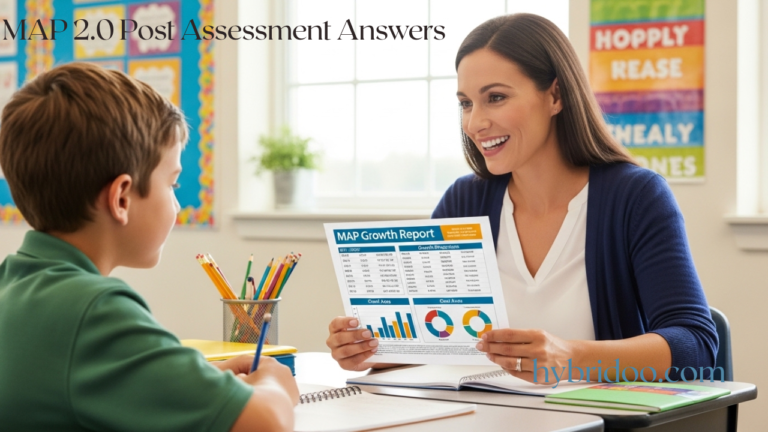
Parents receive a simple Family Report. It shows percentiles and a growth chart in plain language. Share it at conferences. Ask teachers, “How can we support this at home?”
Teachers look at Class Profile reports. They spot patterns across the whole group. One class might need extra fractions work while another flies in comprehension.
Administrators check School and District reports to decide on programs. Everyone works from the same trusted data.
## Get Ready for Your Next MAP 2.0 Test in 2026
The best way to improve future map 2.0 post assessment answers is steady practice all year. Review weak skills weekly instead of cramming. Keep a positive attitude—tell yourself, “I get a little better every test.”
Schools in 2026 focus more on personalized learning. Your map 2.0 post assessment answers help teachers match you with the right lessons, apps, or small-group help. Use that advantage.
## Final Thoughts: Your Map 2.0 Post Assessment Answers Are a Starting Line, Not a Finish
Those numbers do not define you. They simply show where you stand today and how far you have come. In 2026, students who treat their map 2.0 post assessment answers as helpful feedback grow the most.
You now know exactly what the scores mean, how to read the reports, and what practical steps to take. Share this guide with friends or family. Talk about results openly. Celebrate every point of growth.
References
- NWEA. (2026). MAP Growth. https://www.nwea.org/map-growth/
- NWEA. (2025). MAP Growth Norms. https://www.nwea.org/map-growth-norms/
- NWEA Blog. (2026, January 27). 12 common questions parents ask about MAP Growth. https://www.nwea.org/blog/2026/12-common-questions-parents-ask-map-growth-assessment/
- NWEA News Center. (2026). NWEA Experts Outline Key Education Trends to Watch in 2026. https://www.nwea.org/news-center/press-releases/nwea-experts-outline-key-education-trends-to-watch-in-2026/
- NWEA Family Guide to MAP Growth (2025 update). Available via NWEA resources.
All facts come directly from NWEA’s official 2025–2026 materials. We built this guide to help real families and classrooms succeed.