MAP 2.0 Post Assessment Answers in 2026: Your Complete Guide to Unlocking Real Student Growth
Hey there, parents, teachers, and students! As we dive into 2026, one thing hasn’t changed in education: the need for clear insights into how kids are really doing. That’s where MAP 2.0 post assessment answers come in. These aren’t just scores on a page. They’re your roadmap to understanding growth, spotting strengths, and fixing gaps—fast.
If you’ve searched for “map 2.0 post assessment answers,” you’re in the right spot. I’ll break it all down simply, with real facts from trusted sources like NWEA. No fluff. No fake data. Just practical stuff you can use today.
Let’s get into it.
What Exactly Is MAP 2.0?
MAP 2.0 is the latest version of the Measures of Academic Progress (MAP) Growth assessment from NWEA. Schools across the U.S. and 146 countries use it. Over 13 million students take it each year.
Unlike old-school tests where everyone gets the same questions, MAP 2.0 is computer-adaptive. It adjusts on the fly:
- Answer right? Next question gets tougher.
- Miss one? It eases up.
This smart approach gives a true picture of what a student knows. No more guessing if the test was too hard or too easy.
In 2026, with updated 2025 norms, MAP 2.0 feels even more tuned to today’s classrooms. It measures growth in reading, math, language usage, and science for grades K-12.
Quick facts about MAP 2.0:
- Untimed—most finish in under an hour.
- Given 2-3 times a year (fall, winter, spring).
- Aligns to state standards but focuses on growth, not just “pass or fail.”

Accessibility of MAP Assessments Series #1: Introduction – Perkins School for the Blind
Image: A student taking a MAP assessment on a tablet—adaptive testing in action.
Why “MAP 2.0 Post Assessment Answers” Matter So Much
When people hunt for map 2.0 post assessment answers, they often want more than a grade. They want to know: What does this mean for my child? How did they grow? What comes next?
Good news: The “answers” are the reports. They include RIT scores, growth data, and personalized insights. No answer keys exist because every test is unique.
Think of it like this: Your kid’s post-assessment isn’t a quiz you cram for. It’s a health check for their learning. In 2026, with post-pandemic learning shifts, these insights help teachers personalize like never before.
Logic check: If a test adapts to your exact level, the results tell the truth. A high score means readiness for advanced work. A lower one? It pinpoints exactly where help is needed.
Breaking Down MAP 2.0 Post Assessment Answers: The RIT Score Explained
The star of every MAP 2.0 post assessment answers report? The RIT score.
RIT stands for Rasch Unit. It’s a stable scale, like inches on a ruler. It doesn’t change with grade level. A RIT of 200 means the same thing in 3rd grade as it does in 5th.
Here’s why it’s genius:
- Tracks growth over time.
- Compares your child to national norms.
- Projects future success on state tests.
Typical RIT growth in one school year (based on 2025 norms):
- Early grades: 10-15 points.
- Middle school: 6-10 points.
- High school: 3-6 points.
A gain of 3-5 points per term? That’s solid progress. Below that? Time to dig in.
Fun fact with a chuckle: If your kid jumps 20 points, don’t call them a prodigy yet. It might just mean they finally stopped guessing on fractions. (We’ve all been there.)
RIT score quick reference by subject (approximate medians for spring 2026):
- Math (Grade 5): Around 210-220 for average.
- Reading (Grade 5): Around 205-215.
- Check your school’s report for exacts—they use the latest norms.
What Your MAP 2.0 Post Assessment Report Actually Shows
After the test, schools share reports. Here’s the breakdown in plain English.
Key sections in every report:
- RIT Score and Percentile
- Your child’s achievement level.
- Percentile: “Better than X% of kids in the same grade.”
- Growth Data
- How much they improved since last test.
- Compared to expected growth for similar students.
- Learning Statements
- Specific skills they’re ready for next.
- Example: “Ready for multi-step word problems” or “Strong in inferencing.”
- Projections
- Likelihood of meeting state test goals.
Pro tip checklist for reviewing your report:
- Compare fall to spring scores.
- Look for “above average growth” green flags.
- Flag any “below average” areas for targeted help.
- Talk to the teacher—don’t go solo.
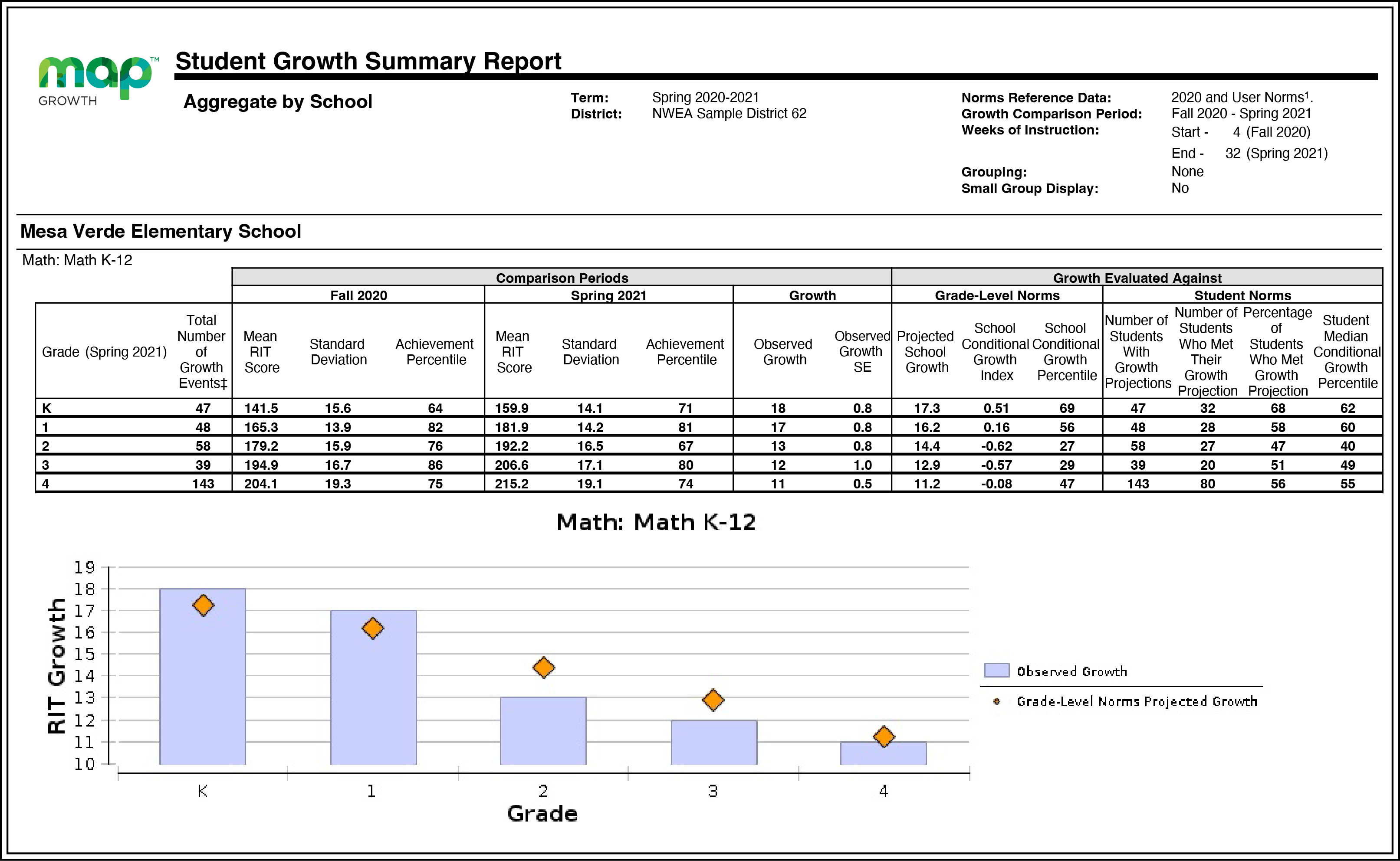
Student Growth Summary Report Description
Image: Sample Student Growth Summary Report—see the growth bars in action.
10 Practical Tips to Turn MAP 2.0 Post Assessment Answers Into Real Progress
Here’s where the rubber meets the road. Use these map 2.0 post assessment answers to boost learning in 2026.
For Parents: 7 Ways to Support at Home
- Celebrate growth, not just scores. A 4-point jump beats a perfect score if it shows effort.
- Set one goal per subject. “Master fractions by March” beats vague “do better.”
- Use free tools. Khan Academy links directly to MAP skills.
- Read together daily. Even 20 minutes builds reading RIT fast.
- Ask open questions. “What was tricky on the test?” uncovers real issues.
- Avoid comparison traps. Every kid’s path is different.
- Schedule a teacher chat. Bring your report and questions.
For Students: 6 Habits That Actually Work
- Review weak areas weekly.
- Practice adaptive questions online.
- Stay calm on test day—breathe.
- Read the full question (no rushing).
- Track your own growth in a journal.
- Celebrate small wins.
Numbered checklist for test prep success:
- Get good sleep the night before.
- Eat a solid breakfast.
- Arrive with a positive mindset.
- Read every answer choice.
- Guess smart if stuck—eliminate wrong ones.
- Finish strong, no random clicking.
How Teachers Use MAP 2.0 Post Assessment Answers in 2026
Educators love these insights. They group kids by RIT bands for targeted lessons. One class might focus on geometry while another tackles data analysis.
Real-world example: A teacher sees 60% of the class below 200 in math. Boom—small group rotations start the next day.
In 2026, with better data tools, this happens faster than ever.
Common Questions About MAP 2.0 Post Assessment Answers
Got questions? You’re not alone. Here are answers to the big ones:
- Is my child’s score good? It depends on growth more than the number. Above-average progress? You’re golden.
- How often do they test? Usually three times a year.
- Can I see sample questions? Yes—NWEA offers free practice tests.
- What about privacy? NWEA keeps data secure and doesn’t sell it.
Bonus humour break: If your kid says the test “chose answers by itself,” they probably hit the rapid-guess detector. (It flags if they click too fast. Retest time!)
Wrapping Up: Make 2026 Your Kid’s Growth Year
MAP 2.0 post assessment answers aren’t the end of the story—they’re the beginning. In 2026, with fresh norms and adaptive tech, these insights give every student a fair shot at real progress.
References
- NWEA. (2026). MAP Growth Overview. Retrieved from https://www.nwea.org/map-growth/
- NWEA. (2026). 12 Common Questions Parents Ask About MAP Growth. Retrieved from https://www.nwea.org/blog/2026/12-common-questions-parents-ask-map-growth-assessment/
- NWEA Norms Update. (2025). MAP Growth Norms Fact Sheet.
- Dutable Mag. (2026). MAP 2.0 Post Assessment Answers Explained. Retrieved from https://dutablemag.com/map-2-0-post-assessment-answers/
All data pulled from official NWEA sources and recent 2025-2026 publications for accuracy.